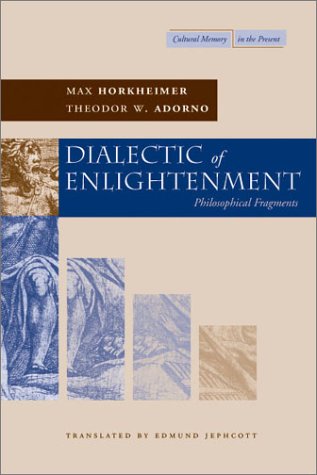
Horkheimer, Max, and Theodor W. Adorno. Dialectic of Enlightenment. New York: Continuum, 1993. Print. Summary:In this chapter of Dialect of Enlightenment, Adorno and Horkheimer seek to undermine the idea that enlightenment is higher hierarchically than mythology. The enlightenment claims that their locus of truth is located outside of the self and found through abstraction, making more objective or real. However, Adorno and Horkheimer instead show how the enlightenment itself is a mythology. They also explain that humans only want to know about nature in order to subdue it and others (4). Then they show how the dichotomy created between science and poetry is carried out in language (17). Later they seek to situate the concept of the self within this framework and how the individual is connected to economic concerns and labor (29).Response:One concept that seemed to creep up throughout the piece was the element of fear. Midway through they say that “Man imagines himself free from fear when there is no longer anything unknown” (16). I have heard it said before that men create mythologies to account for things they do not understand, but it was interesting that they link this then to the enlightenment concepts as well. It seems then that fear must be somehow intertwined with curiosity. We claim that we are curious about things and so we search for answers, creating constructs within which to understand the world around us, so then it seems that they would suggest that behind this curiosity might be an element of fear as well. Because when I think about even my own enjoyment of learning and curiosity, when I ask myself why I want to know something, there is some element within me that is deeper than just, “because I just want to know” or “I find it interesting.” The deeper I probe with the Why? game, the closer it seems it might be to a fear of the unknown.Connections/Questions:Adorno and Horkheimer question positivism and say that it “represents the court of judgement of enlightened reason, to digress into intelligible worlds is no longer merely forbidden, but meaningless prattle” (25). Although we have not read Marx directly in this course, they are clearly directly influenced by his concepts and focus on economy and its relationship to people. Also, they are responding to Kant’s assertion that enlightenment gives people freedom from authority. Looking back now, I can see how they connect to Zebroski’s question I responded to about writing as an art or a science or both or neither. This question and the creation of dichotomies to respond to a desire to define is clearly one that has been thought about by many others for centuries, and it is interesting to see that the debate continues on. |
Quotations: “When public opinion has reached a state in which thought inevitably becomes a commodity, and language the means of promoting the commodity, then the attempt to race the course of such depravation has to deny any allegiance to current linguistic and conceptual conventions, lest their world-history consequences thwart it entirely” (xii). “[M]yth is already enlightenment; and enlightenment reverts to mythology” (xvi). “In the most general sense of progressive thought, the Enlightenment has always aimed at liberating me from fear and establishing their sovereignty. Yet the fully enlightened earth radiates disaster triumphant. The program of Enlightenment was the disenchantment of the world; the dissolution of myths and the substitution of knowledge for fancy” (3). “For enlightenment is as totalitarian as any system” (24). “For the scientific mind, the separation of thought from business for the purpose of adjusting actuality, departure from the privileged area of real existence, is as insane and self-destructive as the primitive magician would consider stepping out of the magic circle he has prepared for his invocation; in both cases the offense against the taboo will actually result in the malefactor’s ruin” (26). |